
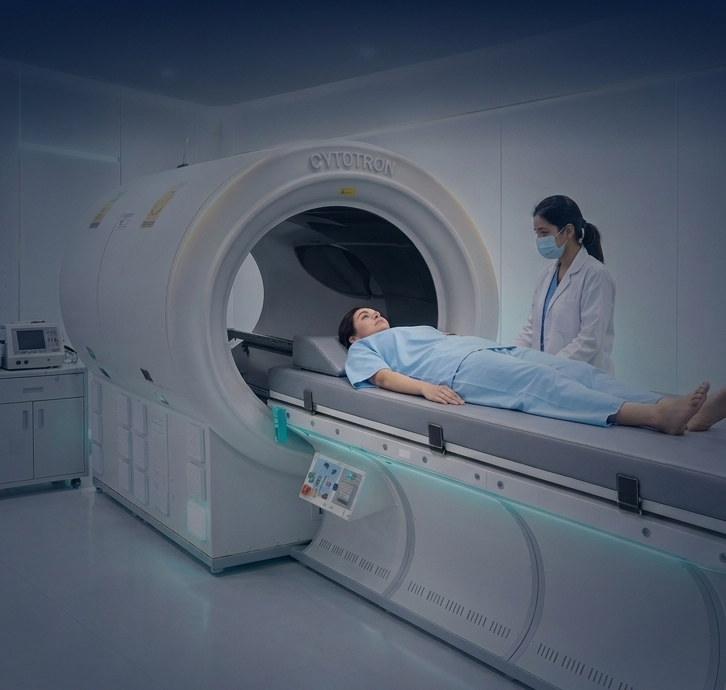
Patient lying on a hospital bed before entering a large CT scanner with a masked healthcare worker nearby.

What is Cytotron?

Cytotron is an active therapeutic medical device that uses Rotational Field Quantum Magnetic Resonance - Fast Radio Burst (RFQMR-FRB) — a proprietary technology developed by Dr. Rajah Vijay Kumar over three decades of research at Scalene Cybernetics, Bengaluru. Unlike diagnostic MRI, which uses magnetic resonance to create images, Cytotron uses precisely controlled electromagnetic beams to modulate cellular behaviour at a biophysical level.

The device generates multi-frequency, non-thermal, non-ionising electromagnetic pulses focused on target tissues. These pulses interact with the Transmembrane Potential (TMP) of cells — the voltage difference across the cell membrane that governs cellular repair, communication, and proliferation. By engineering the TMP, Cytotron can either stimulate regeneration in damaged tissues or suppress abnormal cell growth.

The Science: Transmembrane Potential

Every cell maintains a voltage difference across its membrane — the Transmembrane Potential (TMP). In healthy cells, TMP ranges from −70 to −90 millivolts. In diseased states — cancer, arthritis, neurodegeneration — this potential is disrupted, leading to cellular malfunction.

RFQMR-FRB beams act as biophysical signals that engineer the TMP of target tissues. In neurology, this modulation stimulates neural progenitor cells, promotes neuroprotection, and supports regeneration of damaged neural pathways. In oncology, it triggers tumour suppression mechanisms. In musculoskeletal conditions, it stimulates cartilage regeneration.
Every cell maintains a voltage difference across its membrane — the Transmembrane Potential (TMP). In healthy cells, TMP ranges from −70 to −90 millivolts. In diseased states — cancer, arthritis, neurodegeneration — this potential is disrupted, leading to cellular malfunction.

RFQMR-FRB beams act as biophysical signals that engineer the TMP of target tissues. In neurology, this modulation stimulates neural progenitor cells, promotes neuroprotection, and supports regeneration of damaged neural pathways. In oncology, it triggers tumour suppression mechanisms. In musculoskeletal conditions, it stimulates cartilage regeneration.

Safety Profile

Cytotron operates exclusively in the non-ionising electromagnetic spectrum — the same broad category as radio waves and MRI scanners. The technology is:
Hexagon outline with a DNA strand crossed out by a diagonal line ending in a circle.
Non-ionising
Zero risk of DNA damage or cellular mutation
Thermometer icon enclosed in a circle inside a diamond-shaped frame.
Non-thermal
No tissue heating
Circle divided diagonally with a paintbrush and pencil on one side, syringe and eraser on the other.
Non-invasive
No surgery, no needles, no pharmaceutical intervention
Outline of a peaceful face with closed eyes surrounded by two curved lines and a small circle.
Painless
Patients feel nothing during treatment

Checkmark inside a circle over a tilted diamond with a small solid circle near the top right corner.
No known side effects
Safe for repeated and long-term treatment
Regulatory Approvals

Regulatory Approvals

Jurisdiction Authority / Certification Scope
India
CDSCO Oncology, Musculoskeletal, Neurological (March 2026)
European Union
CE Mark (2012) Musculoskeletal, Oncology
United States
FDA Breakthrough
Device Designation
(2019)
Breast, Liver, Pancreatic Cancer
Mexico
COFEPRIS (November 2025) Neurological
(via NeuroCytonix México)
Malaysia
Approved Manufacturing & Training Hub
(Asia Pacific)
South Africa
Approved Manufacturing & Clinical Operations
Canada
CMDCAS Qualified Regulatory Compliance
Older man with white beard and hair wearing glasses, a gray blazer, and a purple shirt, arms crossed.

About the Inventor

Cytotron was conceived and developed by Dr. Rajah Vijay Kumar, a pioneering Indian biomedical engineer and Founder-Chairman of Scalene Cybernetics Pvt. Ltd., Bengaluru. Dr. Kumar’s research into rotating electromagnetic field interactions with biological tissue began in 1987 at the Centre for Advanced Research and Development (CARD) in Bengaluru. His three decades of work are embodied in the Cytotron platform — a technology that has transitioned from diagnostic magnetic resonance to a dedicated therapeutic modality.

Device:  Cytotron RTE 6040-864GEN
Technology:  Rotational Field Quantum Magnetic Resonance - Fast Radio Burst (RFQMR-FRB)
Manufacturer:  Scalene Cybernetics Pvt. Ltd., Bengaluru, India
Configuration:  864 quantum resonance guns across 9 sequential axes (A–I)
Frequency Range:  1 kHz to 100 MHz (non-ionising sub-radio and near-radio spectrum)
Treatment Duration:  45–60 minutes per session, 28 consecutive days per cycle